


Blog – HAZERCLOUD

DevOps

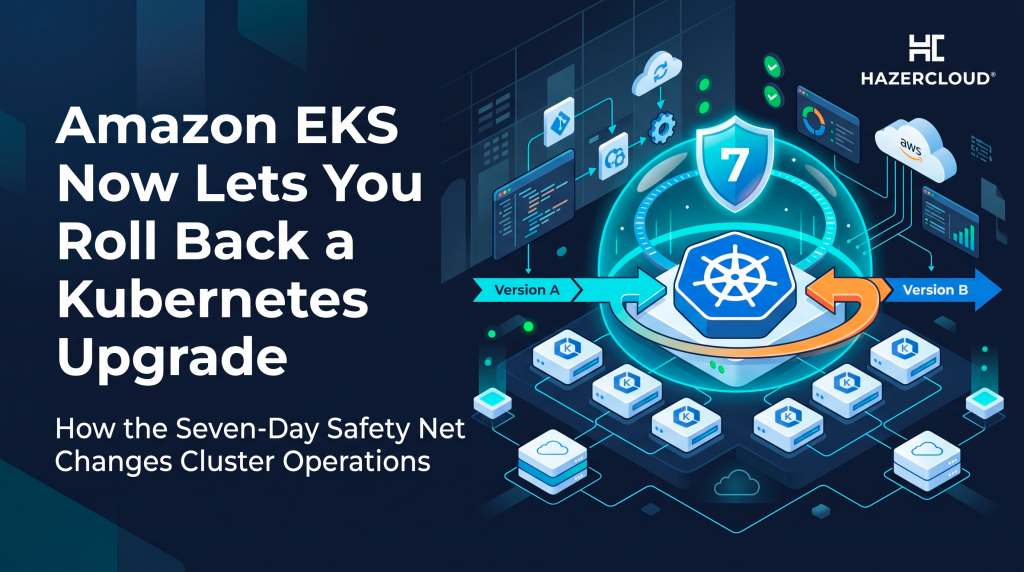
Premium SaaS-style vector illustration for a HAZERCLOUD blog post. The dark navy background features clean typography on the left reading "Amazon EKS Now Lets You Roll Back a Kubernetes Upgrade." The right side showcases a stylized Amazon EKS cluster with connected worker nodes, deployment pipelines, and a prominent orange rollback arrow looping from "Version B" back to "Version A." A glowing protective shield marked with a "7" safeguards the cluster, and the HAZERCLOUD logo is placed cleanly in the top-right corner.

Amazon EKS Now Lets You Roll Back a Kubernetes Upgrade: How the Seven-Day Safety Net Changes Cluster Operations

Amazon EKS Now Lets You Roll Back a Kubernetes Upgrade: How the Seven-Day Safety Net Changes Cluster Operations Kubernetes upgrades have always been the part of running EKS that teams quietly dread. You test in staging, you read the deprecation notes, you pick a quiet window, and then you push the button and hope nothing

Amazon EKS Now Lets You Roll Back a Kubernetes Upgrade: How the Seven-Day Safety Net Changes Cluster Operations Read More »

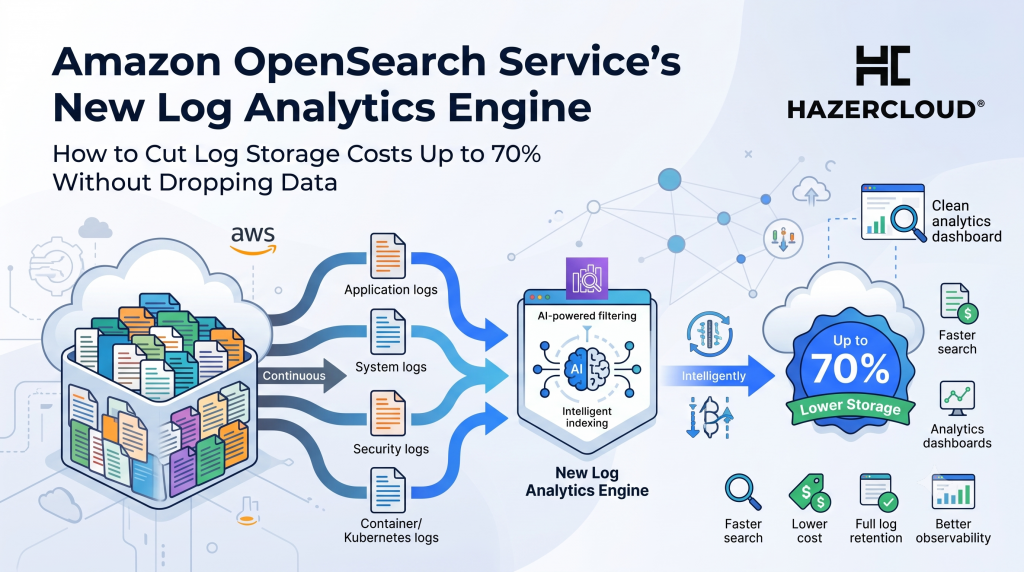
A modern, flat vector illustration showing massive data logs flowing into a central engine labeled 'Intelligent Indexing,' which compresses them into a much smaller storage cloud with a large '70% Lower Storage' badge, emphasizing cost savings.

Amazon OpenSearch Service’s New Log Analytics Engine: How to Cut Log Storage Costs Up to 70% Without Dropping Data

Amazon OpenSearch Service’s New Log Analytics Engine: How to Cut Log Storage Costs Up to 70% Without Dropping Data Every scale-up eventually meets the same wall. The application is growing, the traffic is growing, and quietly the log bill is growing faster than either. Observability, the thing that is supposed to help you find problems,

Amazon OpenSearch Service’s New Log Analytics Engine: How to Cut Log Storage Costs Up to 70% Without Dropping Data Read More »

Amazon ECS Service Connect Now Routes In-Zone by Default: How Zone-Aware Routing Cuts the Cross-AZ Bill You Never See

Amazon ECS Service Connect Now Routes In-Zone by Default: How Zone-Aware Routing Cuts the Cross-AZ Bill You Never See Cross-availability-zone data transfer is the most expensive line item most engineering teams have never looked at. It does not appear as its own charge in the AWS console, it hides inside a regional-bytes usage type that

Amazon ECS Service Connect Now Routes In-Zone by Default: How Zone-Aware Routing Cuts the Cross-AZ Bill You Never See Read More »

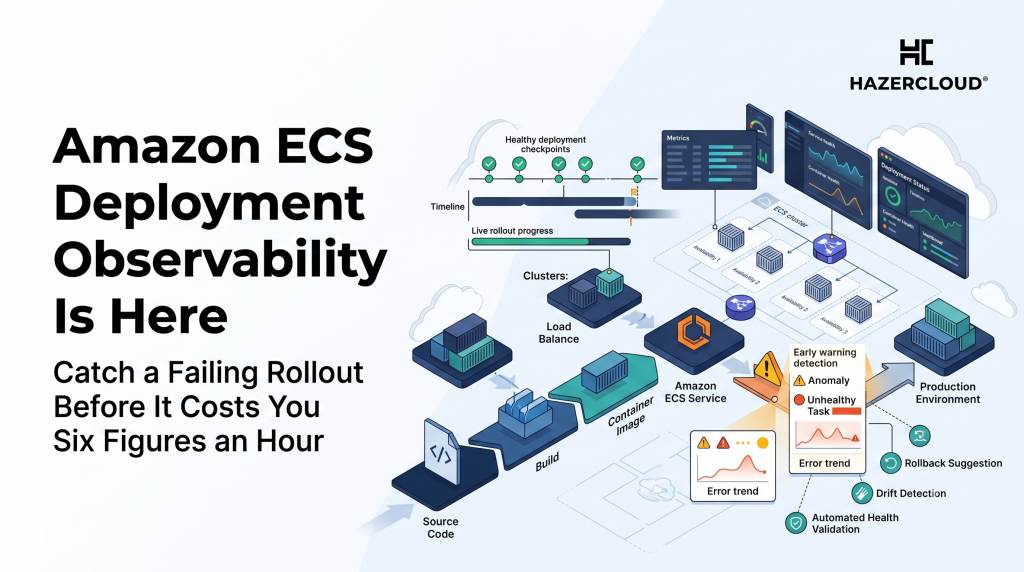
A premium flat-style enterprise tech illustration for a HAZERCLOUD blog post, titled "Amazon ECS Deployment Observability Is Here." The image displays an AWS CloudOps pipeline flowing toward production, highlighting an early warning observability checkpoint catching an anomaly before it hits the live environment.

Amazon ECS Deployment Observability Is Here: How to Catch a Failing Rollout Before It Costs You Six Figures an Hour

Amazon ECS Deployment Observability Is Here: How to Catch a Failing Rollout Before It Costs You Six Figures an Hour ITIC’s 2024 Hourly Cost of Downtime Survey found that more than 90 percent of midsize and large enterprises now lose over 300,000 dollars for every hour their systems are down, and 41 percent put that

Amazon ECS Deployment Observability Is Here: How to Catch a Failing Rollout Before It Costs You Six Figures an Hour Read More »

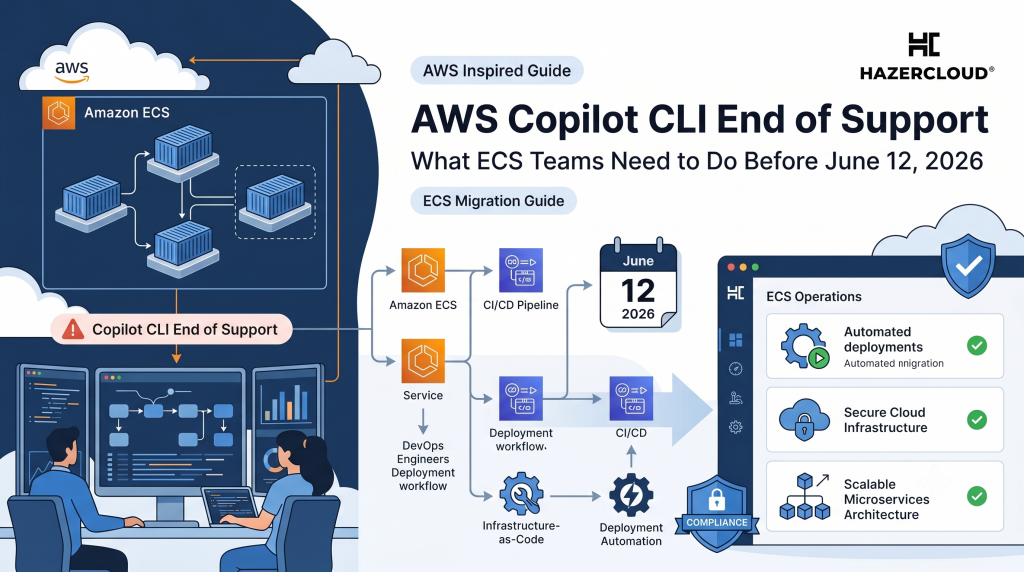
HAZERCLOUD infographic mapping the migration from AWS Copilot CLI to automated ECS operations by June 12, 2026.

AWS Copilot CLI End of Support: What ECS Teams Need to Do Before June 12, 2026

AWS Copilot CLI End of Support: What ECS Teams Need to Do Before June 12, 2026 If your team shipped containers to AWS the easy way over the last few years, there is a fair chance AWS Copilot CLI is sitting somewhere in your release process. On June 12, 2026, that tool reaches end of

AWS Copilot CLI End of Support: What ECS Teams Need to Do Before June 12, 2026 Read More »

How to install node.js on User Level – CentOS RHEL Amazon Linux

This article explains how you can install node package on user-level without having root access. This method was tested on CentOS 7 and Amazon Linux 2. However, this method should work on any Linux version. Please comment below if you are facing any issues. Create a user for your node application. In our case and

How to install node.js on User Level – CentOS RHEL Amazon Linux Read More »

CentOS 6 – YumRepo Error: All mirror URLs are not using ftp, http[s] or file.

Hello folks… Today I was trying to install a package on an old CentOS 6 server and got the below error. Loaded plugins: fastestmirror, presto, security Setting up Install Process Determining fastest mirrors YumRepo Error: All mirror URLs are not using ftp, http[s] or file. Eg. Invalid release/repo/arch combination/ removing mirrorlist with no valid mirrors:

CentOS 6 – YumRepo Error: All mirror URLs are not using ftp, http[s] or file. Read More »

Scroll to Top