



How to Choose an AWS Region for Your UK or European Business in 2026
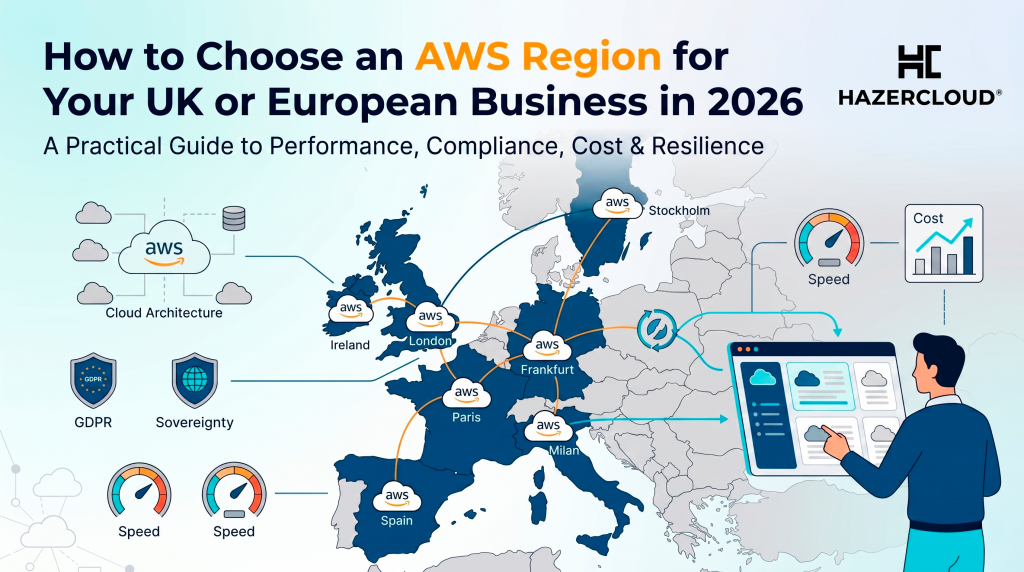
If your business is moving to AWS, or already running on it, one of the first decisions you have made or are about to make is which AWS region to use. It sounds like a technical detail. It is not. The region you pick decides where your customer data physically lives, which laws apply to it, how fast your application feels to users, what it costs to run, and even how easily you can win contracts with enterprise and public-sector buyers. Most UK and EU businesses make this decision once, almost by default, and never revisit it. That can be a quietly expensive mistake.
The short answer for most UK and European businesses on AWS in 2026 is this. Pick the region closest to the majority of your users for performance, but choose it consciously against four other factors: data residency and the laws that apply, pricing differences between regions, the AWS services you actually need, and your resilience strategy across more than one region. For UK businesses that means London is usually the right starting point. For EU-based businesses serving EU customers, Ireland, Frankfurt, Paris, Stockholm, Milan, Spain, or the new AWS European Sovereign Cloud in Brandenburg are all sensible candidates depending on where your customers and data sit.
The Five Things That Should Drive Your Choice
Latency is the easiest factor to understand. The closer your AWS region is to your users, the faster your application feels. A user in London hitting a workload in Ireland feels almost no difference, but a user in Madrid hitting a workload in Stockholm absolutely does. For most businesses, picking a region near your largest user base is the right starting point.
Data residency and sovereignty matter more than they used to. Under UK GDPR and EU GDPR, you are responsible for knowing where personal data is stored and processed, and for justifying any cross-border transfer. Many regulators and enterprise buyers now expect data to stay within a specific country or within the EU itself. Public sector tenders in the UK, Germany, France, and elsewhere often require it explicitly. Choosing your AWS region is the first and most important control you have over this.
Service availability is the factor people forget. Not every AWS service is available in every region. Newer services often launch in US-East-1 or Ireland first, and arrive in smaller European regions months or years later. If your application relies on a specific Amazon Bedrock model, a specific database engine, or a specific networking feature, you need to check it is actually available in the region you want to use.
Pricing varies between regions, sometimes by twenty to thirty per cent for the same service. Ireland is consistently one of the cheaper European regions, London tends to be competitive, and some smaller European regions can be noticeably more expensive for certain services. For a small workload it does not matter much, but for a meaningful production environment the annual difference is real money.
Resilience is the factor most UK and EU businesses underweight, especially after the May 2026 US-EAST-1 outage that took down major services for several hours. If your business cannot tolerate hours of downtime, you should be designing for two regions from day one, not one. Picking your primary region and your future secondary region together leads to a much cleaner architecture than bolting a second region on later in a panic.
The Region Options at a Glance
For UK businesses, Europe (London) is the obvious default, with Europe (Ireland) as the natural secondary region for resilience and lower-cost workloads. For German businesses, Europe (Frankfurt) is the default, increasingly paired with the new AWS European Sovereign Cloud in Brandenburg for workloads with the strictest sovereignty requirements. French businesses tend to default to Europe (Paris), Nordic businesses to Europe (Stockholm), Italian businesses to Europe (Milan), and Spanish or Portuguese businesses to Europe (Spain). Ireland remains the workhorse general-purpose region for many cross-border European businesses because of its pricing and service availability.
The AWS European Sovereign Cloud, which went generally available in Brandenburg in January 2026 with Amazon committing more than 7.8 billion euros of investment, is a genuinely new option. It is physically and logically separated from the rest of AWS, operated exclusively by EU-resident staff, and designed for organisations with the strictest data sovereignty needs, including public sector and regulated industries.
The Bigger Picture
Region choice is no longer a one-off decision made on day one. Data sovereignty rules are tightening across the UK and EU, enterprise procurement teams are asking sharper questions, and the post-May-2026 conversation about multi-region resilience is changing how serious businesses architect their AWS estate. Picking the right region the first time, and planning the second region deliberately, has become a basic operating discipline rather than a niche concern.
What to Do About It
Start with three questions. Where are most of your users today, and where will they be in two years? Which laws and customer expectations apply to the data you handle? And how much downtime, in real money, can your business actually tolerate? With those answers in front of you, the right primary region almost picks itself, and the right secondary region follows naturally. If you already have workloads in a region you chose by default years ago, this is a good moment to revisit that decision, because moving regions later is significantly more painful than getting it right now.
This is exactly the kind of architecture decision HAZERCLOUD helps growing UK, US, and European businesses make every week. We work through your data residency obligations, performance needs, cost targets, and resilience requirements, and recommend the right primary and secondary AWS regions for your business including whether the AWS European Sovereign Cloud is the right fit. If you want a clear, defensible answer rather than a default pick, Get in touch and we will help you choose.
#AWSRegion #AWSCloudComputing #AWSCloud #AWSMigration #CloudStrategy #CloudInfrastructure#GDPRCompliance
