



Why Cloud Migration Projects Still Fail in 2026 – And How to Avoid the Common Traps
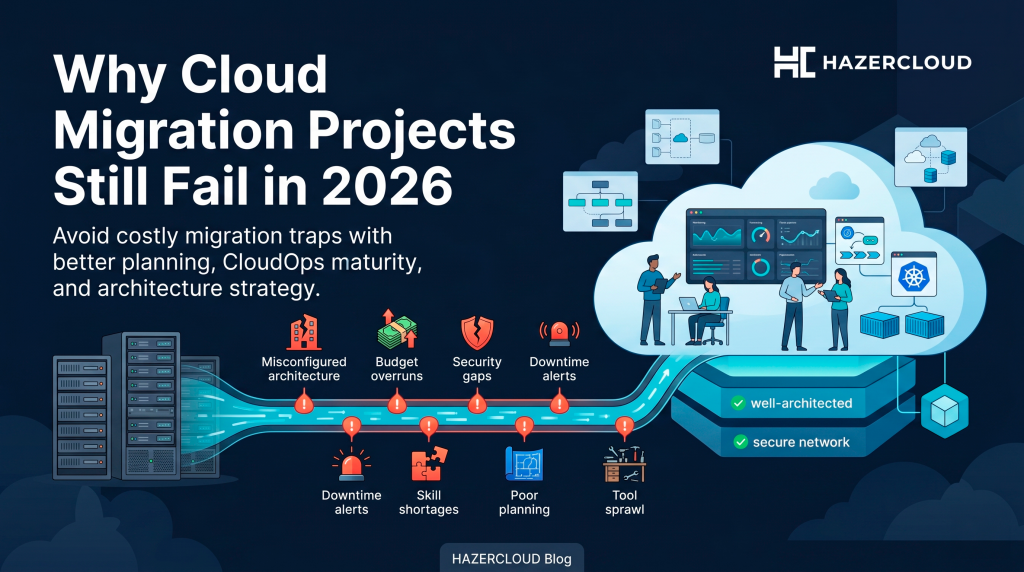
You’d think by now we’d have cloud migration figured out. The tools are better, the playbooks are well-documented, and most businesses understand the benefits. Yet the numbers tell a different story: up to 62% of cloud migration projects either fail outright or prove far more difficult than expected. Nearly four in ten exceed their original budget. And 74% of organisations don’t achieve the expected return on their initial migration.
If you’re planning a move to AWS or another cloud platform, those statistics should give you pause not because migration isn’t worth doing, but because the difference between a smooth transition and an expensive disaster usually comes down to a handful of avoidable mistakes.
The “Just Move It” Trap
The most common failure pattern starts with a perfectly understandable impulse: get off the old infrastructure as fast as possible. Under time pressure, teams default to a lift-and-shift approach taking existing applications and dropping them into the cloud without rethinking how they run. It sounds efficient, but it’s often where the trouble begins.
Applications that were designed for on-premise servers frequently perform poorly in cloud environments. They consume more resources than necessary, drive up costs, and leave stakeholders wondering why they moved at all. The average migration comes in 14% over budget, and a big part of that gap traces back to workloads that needed more refactoring than anyone planned for. Research shows that 30% of applications require significant code changes that weren’t accounted for in the original migration timeline.
Hidden Dependencies Are the Silent Killer
Nearly half of all migration delays 47%, according to recent industry data are caused by legacy application dependencies that weren’t identified during the assessment phase. This is the iceberg problem: the application itself is visible, but underneath it sits a web of databases, APIs, scheduled jobs, messaging systems, and internal services that nobody documented properly.
When one of those connections breaks during migration, everything downstream breaks with it. The fix is rarely quick, and the delay cascades across the project. For businesses in the UK and EU, these surprises become even more costly when they intersect with data residency requirements and GDPR obligations. Moving a database to a different region without understanding where the data flows is the kind of mistake that creates both technical and regulatory headaches.
Why Budgets Keep Blowing Up
Cloud migration budget overruns typically aren’t caused by a single large expense. They accumulate. A 23% average overshoot doesn’t happen because someone forgot to price a service What Actually Works
The organisations that migrate successfully tend to share a few characteristics, and none of them involve being lucky. First, they define measurable success criteria before writing a single line of migration code. That means deciding in advance whether the goal is reduced cost, faster deployment cycles, better resilience, improved compliance posture, or some combination and building the plan around those objectives rather than around a vague desire to “be in the cloud.”
Second, they take a phased approach. Starting with a pilot workload something important enough to be representative but not so critical that a misstep causes a crisis lets the team validate performance, security, and operational readiness before migrating the systems that keep the business running. The lessons from that first workload almost always change how the rest of the migration is planned.
Third, they invest in discovery. A thorough application and infrastructure assessment, including dependency mapping, data flow analysis, and compliance requirements, is the single most effective way to prevent the surprises that cause delays and budget overruns. It’s also the step that gets cut most often when teams are under pressure to start moving.
Finally, they build security and compliance into the migration from the beginning rather than treating it as something to retrofit afterward. Integrating identity management, access controls, and monitoring from day one is dramatically cheaper and less disruptive than bolting it on later. it happens because dozens of small assumptions turn out to be wrong. Teams underestimate the effort required to refactor applications. They overlook training costs for staff who’ve never managed cloud infrastructure. They don’t account for running parallel environments during the transition period. And they almost never budget enough for testing.
Network connectivity is another hidden cost centre. More than half of migrations experience delays due to bandwidth bottlenecks between on-premise systems and the cloud. If your data transfer takes twice as long as planned, that’s twice the parallel-running costs and twice the project management overhead.
What Actually Works
The organisations that migrate successfully tend to share a few characteristics, and none of them involve being lucky. First, they define measurable success criteria before writing a single line of migration code. That means deciding in advance whether the goal is reduced cost, faster deployment cycles, better resilience, improved compliance posture, or some combination and building the plan around those objectives rather than around a vague desire to “be in the cloud.”
Second, they take a phased approach. Starting with a pilot workload something important enough to be representative but not so critical that a misstep causes a crisis lets the team validate performance, security, and operational readiness before migrating the systems that keep the business running. The lessons from that first workload almost always change how the rest of the migration is planned.
Third, they invest in discovery. A thorough application and infrastructure assessment, including dependency mapping, data flow analysis, and compliance requirements, is the single most effective way to prevent the surprises that cause delays and budget overruns. It’s also the step that gets cut most often when teams are under pressure to start moving.
Finally, they build security and compliance into the migration from the beginning rather than treating it as something to retrofit afterward. Integrating identity management, access controls, and monitoring from day one is dramatically cheaper and less disruptive than bolting it on later.
The Bigger Picture
Cloud migration is not a one-time project it’s the beginning of a new operating model. The companies that treat it as a checkbox exercise tend to end up with higher costs and frustrated teams. The ones that treat it as a strategic shift in how they build, deploy, and manage technology tend to see the returns they were promised.
The good news is that success rates are improving. On-time, on-budget completions have risen from 54% in 2022 to 65% today, as methodologies and tooling have matured. But that still means one in three migrations goes sideways. If your business is planning a move to AWS and you’d rather be in the successful majority, the time to get the planning right is before the project starts not after it’s already in trouble.
HAZERCLOUD helps businesses across the UK, Europe, and the Middle East plan and execute cloud migrations that actually deliver on their promise. If you’re evaluating a migration or recovering from one that didn’t go as planned, we’d welcome the conversation. Get in touch
