



AWS DevOps Agent Now Reviews Releases Before Production
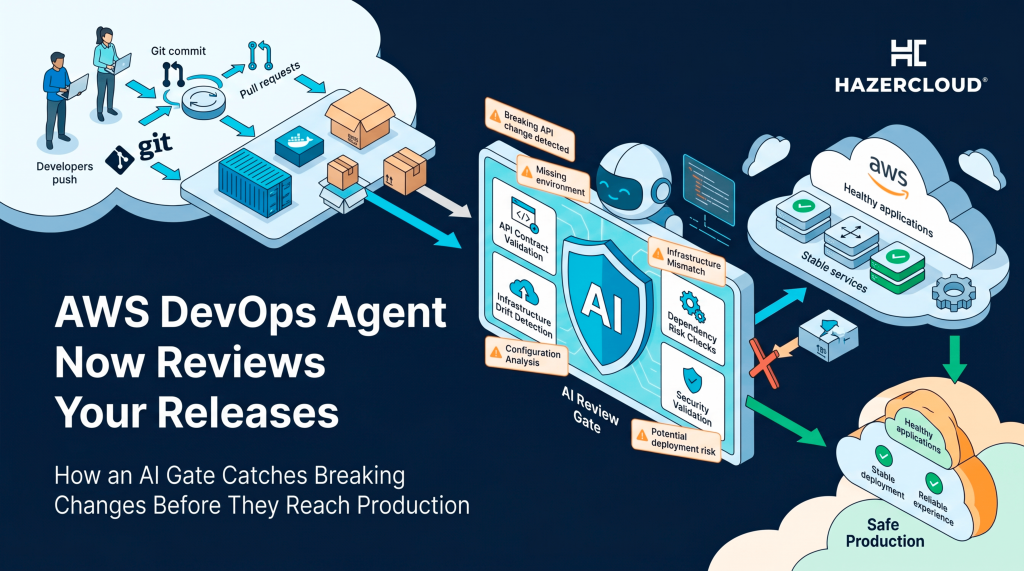
Your team has never shipped code faster, and that is exactly the problem. AI coding assistants now write a large share of the pull requests moving through your pipeline, but the people who review and test those changes are still working at human speed. The result is a growing queue of changes that either wait too long for a careful review or get waved through without one. AWS has just put an AI teammate at that bottleneck. On 17 June 2026, at the AWS Summit in New York, AWS announced a new release management capability for AWS DevOps Agent, in preview, that reviews code changes for release readiness and runs change specific tests in production like environments before the change merges. For any founder or engineering leader who worries about what a bad merge could do to a live system, this is worth understanding.
The short answer is this. AWS DevOps Agent can now sit between a pull request and production, read the change in the context of your whole system, and tell you whether it is safe to release, safe to release with caution, or should be blocked. It checks cross repository dependencies to find breaking changes before merge, reviews access control changes against AWS Well-Architected best practices, runs your software in an isolated environment to confirm it builds and passes basic checks, and for web and API applications it generates a test plan tailored to that specific change and runs it for you. It is available in preview at no additional cost in the US East (N. Virginia) region, and findings show up in the AWS DevOps Agent console and as comments on pull requests in GitHub or GitLab. In plain terms, it is an automated reviewer that understands your services well enough to catch the failures a rushed human reviewer would miss.
Why This Matters More Than the Average AWS Launch
Most product launches make an existing job a little easier. This one targets a risk that has been quietly getting worse all year. When a team adopts AI coding tools, the volume of changes climbs faster than the review and testing process can absorb. Under that pressure, two bad things happen. Reviews get approved without real scrutiny because the queue is long and the deadline is close, and test environments slowly drift away from what production actually looks like, so passing tests stop meaning very much. The value your engineers create then sits stuck in a review queue instead of reaching customers, and the changes that do slip through carry more risk than anyone signed off on.
For a scale-up, that risk is not abstract. A single change that quietly expands an IAM permission, breaks a shared API that three other services depend on, or assumes a config value that does not exist in production can turn into an outage, a security incident, or a long Friday night. The cost is rarely just the downtime. It is the trust you lose with customers and the time your best engineers spend firefighting instead of building. A release gate that reasons about the blast radius of a change before it merges is aimed squarely at that cost.
What the Release Readiness Review Actually Does
The release readiness review evaluates every code change against three things: your production requirements, the safety of its dependencies, and the standards you have written down in plain English. You do not need to learn a policy language. You describe your internal rules in normal sentences, for example that data at rest must be encrypted, that network access changes need extra care, or that certain applications handle sensitive data and must clear a higher bar. When you have not defined any standards, the agent falls back on general best practices, so you get value on day one and tighten it over time.
Underneath that, the agent does work that a human reviewer rarely has time for. It maps dependencies across your repositories, so when a change alters a shared interface, it can tell you which downstream services will break, down to the specific files and line numbers, and what to do about it. It checks access control changes against the AWS Well-Architected Framework, which matters because permission creep is one of the most common and least noticed ways a system becomes insecure. It also runs your software in an AWS managed isolated environment and executes lightweight user journey tests to confirm the change actually builds and runs before it ever enters the pipeline. The output is not a vague score. It is a recommendation of block, proceed with caution, or safe to release, backed by an analysis of why, a list of issues ranked by severity, and concrete steps to fix each one.
Autonomous Testing That Reasons About the Change
The second half of the launch goes further than review. The autonomous release testing feature generates and runs a test plan built for the specific change in front of it, in a production like environment you provide, before the change merges. This is the part that separates it from the static test suites most teams rely on. Instead of running the same fixed set of tests for every change and hoping they cover the new behaviour, the agent reasons about what the change does and constructs tests around that, covering functional correctness, behavioural regressions, and integration scenarios a hand maintained plan might never have anticipated.
Every run produces structured artifacts, including metrics, logs, traces, and an execution summary, so reviewers get a consistent and auditable record of what was tested and what happened. That record matters for more than engineering tidiness. If you operate under SOC 2, ISO 27001, or a sector framework, being able to show that every production change was tested and reviewed against defined standards is the kind of evidence auditors ask for. You can trigger all of this from the console, from a pull request, or from your IDE through the Kiro or Claude Code plugin, which means a developer can catch a dependency risk or a permissions mistake before the code is even committed.
The Honest Caveats Before You Get Excited
This is a preview, and previews come with real limits. The features are available only in US East (N. Virginia) for now, so if your workloads and your team sit in London, Frankfurt, or Dublin, you will be evaluating this from a distance until broader regional support arrives. Preview pricing is free today, but that will change, and you should assume the eventual cost will need to earn its place against the outage and incident time it saves. The agent reviews repositories in GitHub or GitLab, so it fits teams already on those platforms more naturally than teams on other version control systems.
There is also a cultural point that no tool solves for you. An AI reviewer that says proceed with caution is only useful if your team has agreed what to do when it says that. A gate that everyone learns to override becomes theatre. The teams that get value from this will be the ones that treat the agent as a genuine check, write down the standards they actually care about so the reviews reflect their real risk tolerance, and keep their production like test environments close enough to production that the results mean something. The tool raises the ceiling on what is possible. It does not replace the discipline.
What to Do About It
If you run engineering at a scale-up, the sensible move is not to roll this into your critical pipeline tomorrow. It is to run a controlled trial. Pick one or two repositories that already live in GitHub or GitLab and that you can point at the US East region, connect them to the agent, and let it index your code and build its dependency graph. Then spend a week writing your real standards in plain English, the ones that reflect how you actually think about encryption, access control, and sensitive data, rather than a generic checklist. Run release readiness reviews on a handful of recent changes you already understand, and compare the agent’s verdict to what your team concluded. That tells you quickly whether the recommendations are trustworthy in your context.
From there, decide where a gate like this earns its keep. Many teams will find the highest value sits on the changes that scare them most, the ones touching shared services, infrastructure, or permissions, rather than on every trivial commit. The goal is not to automate away your reviewers. It is to give them an always available second pair of eyes that never gets tired, never skips the dependency check because the release is late, and leaves a clean record of every decision behind it.
If your team is shipping faster than it can safely review, and you would rather get ahead of that than learn the hard way, this is a good moment to look at how your release pipeline, your test environments, and your AWS guardrails fit together. HAZERCLOUD helps founders and engineering leaders build AWS platforms that stay safe at speed, from CI/CD and Well-Architected reviews to the kind of release controls this launch points toward. Book a free consultation at https://hazercloud.com/contact/ and we will help you work out where automated release gates fit in your stack and how to adopt them without slowing your team down.
