



AWS Cut GPU Management Fees by Up to 60%: What ECS and EKS Auto Mode Users Should Do Now
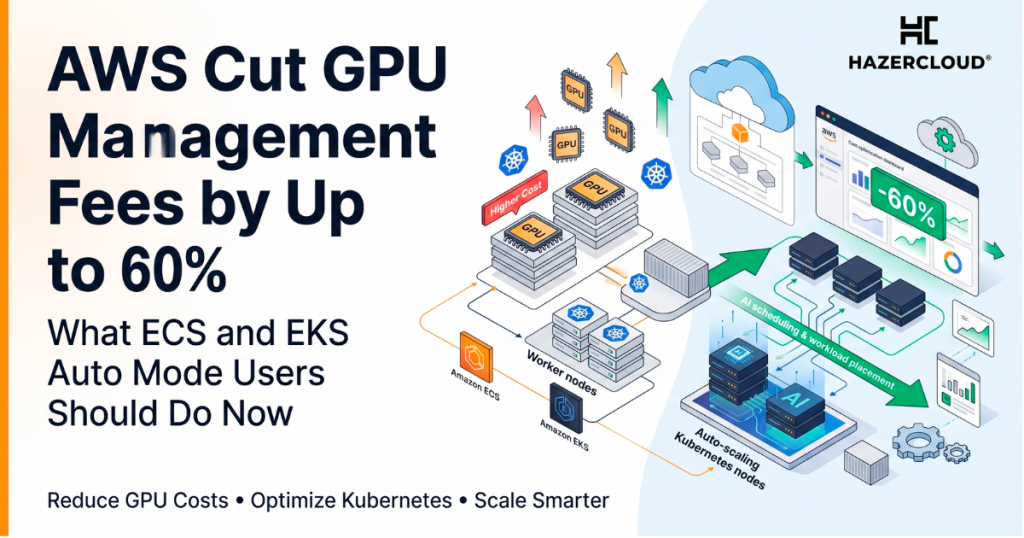
If GPUs are now the fastest-growing line on your AWS bill, a quiet pricing change from the first week of July is worth your attention. On July 7, 2026, AWS announced that management fees for GPU and accelerated instances on Amazon ECS Managed Instances and Amazon EKS Auto Mode are being cut, effective back to July 1. G-series fees drop by 35 percent, and P-series and AWS Trainium fees drop by 60 percent. For any team running machine learning inference, fine-tuning, rendering, or batch jobs on managed containers, this lands directly on a cost center that has been growing faster than almost anything else in the cloud budget.
The short version is this: the AWS Cut GPU Management fees apply to the management fee that Amazon ECS Managed Instances and Amazon EKS Auto Mode charge on top of your EC2 GPU compute, not to the price of the GPU instances themselves. It is automatic, so if you already run GPU workloads on either service, you pay less starting July 1 with no action required. The catch is that a lower management fee does nothing about the much larger problem sitting underneath it: most teams waste between 35 and 60 percent of their GPU spend on idle and oversized accelerators, and no automatic discount touches that. This post explains what actually changed, how much it moves your bill, and where the real money still hides.
What Actually Changed on July 1
AWS reduced the per-hour management fee that these two managed services add to GPU and accelerated instances. On Amazon ECS Managed Instances, G-series management fees are down 35 percent, and P-series and AWS Trainium fees are down 60 percent, according to the AWS What’s New post from July 7. Amazon EKS Auto Mode received an identical cut on the same date, with G-series down 35 percent and P-series and Trainium down 60 percent. Both changes are live in every AWS Region where the respective service is offered, and both apply automatically to existing GPU workloads.
It helps to be precise about what a management fee is, because that is where teams misread this news. ECS Managed Instances and EKS Auto Mode both provision, configure, and operate EC2 instances inside your account for you. You define the task or pod requirements, and the service handles the instance selection, patching, GPU health monitoring, and node repair. For that operational work AWS charges a management fee per instance hour, layered on top of the normal EC2 price. The July change reduces that layer. The underlying EC2 GPU rate, the part that dominates the bill, is unchanged.
How Much This Moves Your Bill
The honest answer is that it depends on how heavily you were leaning on the managed layer, and the effect is real but modest relative to total GPU spend. GPU compute is expensive in absolute terms, which is exactly why any percentage cut is welcome. An NVIDIA H100 instance on AWS, the p5.48xlarge with eight H100 GPUs, costs 98.32 dollars per hour on demand according to figures compiled by Spendark and LeanOps in 2026. Run one of those around the clock and you are past 70,000 dollars a month before you count storage, data transfer, or managed-platform surcharges. Against numbers like that, trimming the management layer by 35 to 60 percent is money worth having, but it is a trim, not a transformation.
Put it in context and the shape of the opportunity becomes clear. GPU now accounts for 18 percent of spend at AI-forward enterprises, up from just 4 percent in 2023, according to the State of FinOps 2026 survey. Managed-platform surcharges are their own tax on top of raw compute: SageMaker adds roughly 30 to 40 percent over the underlying EC2 rate, per Spendark’s 2026 cost breakdown. ECS Managed Instances and EKS Auto Mode management fees are smaller than that, but they are the same category of cost, and cutting them narrows the gap between fully managed convenience and running your own capacity. If you had avoided the managed services specifically because of the fee, this change is a reason to re-run that math.
Where the Real Money Still Hides
Here is the part that matters more than the discount. A cheaper management fee does not fix utilization, and utilization is where GPU budgets go to die. Static GPU deployments run at only 30 to 40 percent utilization, and idle accelerators are the single biggest source of machine learning waste, according to Spendark. LeanOps, which audits AI infrastructure cost for a living, puts it more bluntly: the average AI team wastes 35 to 60 percent of its GPU cloud spend. No automatic fee cut recovers any of that.
The reason GPU waste is so severe is that the cost of being wrong is an order of magnitude higher than on ordinary compute. LeanOps frames it well: being 20 percent inefficient on a web server costs about 500 dollars a month, while being 20 percent inefficient on a GPU cluster costs about 14,000 dollars a month. A single p4d.24xlarge left running idle over one weekend, roughly 48 hours, burns about 1,573 dollars for nothing. Over a month of occasional overnight and weekend idling, the waste on one instance typically reaches 3,000 to 8,000 dollars. Multiply that across a fleet and the management fee cut is rounding error by comparison.
There is also a structural shift underneath all of this that changes where you should look. Inference, not training, now eats roughly 80 percent of AI infrastructure budgets across AI-forward organizations, up from a training-dominated split just two years ago, according to GPUnex figures cited by Spendark in 2026. That inverts the old instinct to obsess over training runs. If most of your GPU money now goes to serving models 24 hours a day, then scale-to-zero, right-sized inference instances, and shared multi-model endpoints are worth far more than any change to the managed fee.
What to Do About It
Take the fee cut, because it is free, then treat it as a prompt to fix the expensive problems it does not touch. Start by confirming the reduction actually shows up. Pull your Cost and Usage Report for the first two weeks of July and compare the ECS Managed Instances or EKS Auto Mode management-fee line against late June for the same GPU workloads. The change is automatic, but verifying it is how you catch tagging or account-mapping surprises before they compound.
Then go after utilization, which is where the leverage is. Implement scale-to-zero so GPUs only run when jobs are active, a policy that Spendark and LeanOps both report saves 20 to 35 percent of total GPU spend on its own. Right-size the accelerator to the workload rather than defaulting to the biggest card available, since running a model that fits in 24 gigabytes on an 80 gigabyte A100 means paying more than three times over for memory you never touch. Move checkpoint-friendly training onto Spot capacity, where the 60 to 90 percent discount is the highest-impact single optimization for training-heavy teams. And because inference now dominates the bill, put your best engineering time into serving efficiency: warm pools, aggressive scale-up thresholds, and shared endpoints for low-traffic models.
None of this is exotic, but it takes deliberate ownership, and the teams that treat GPU cost as someone else’s problem are exactly the ones sitting at 30 percent utilization. If your GPU bill has been climbing faster than your understanding of it, HAZERCLOUD can help. We run a free consultation and cloud cost assessment for teams on AWS, and we will show you where your accelerator spend is actually going and what to change first. Book a session at https://hazercloud.com/contact/ and we will bring the numbers.
