



AWS Continuum: How Machine-Speed Security Clears the Vulnerability Backlog Your Team Cannot Fix by Hand
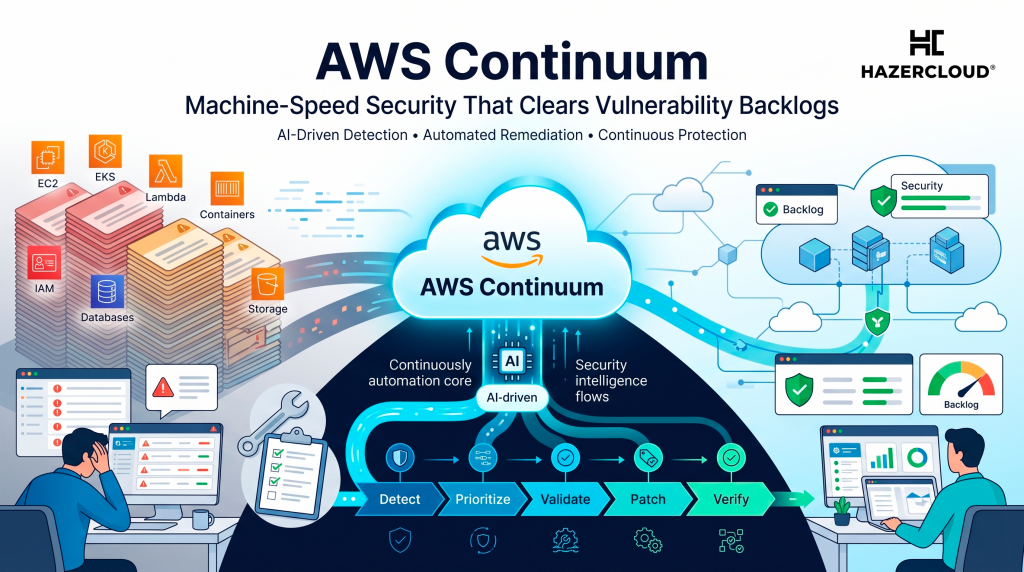
Most security teams are not losing because they cannot find vulnerabilities. They are losing because they find too many. Every scanner, every dependency check, and now every AI model that reads code produces another pile of findings, and the queue grows faster than any human team can work through it. AWS Continuum, announced at the AWS Summit in New York and now available, is Amazon’s attempt to change that maths. Instead of handing you yet another dashboard of alerts, it tries to run the whole lifecycle of a code vulnerability, from discovery to a recommended fix, at the same speed the problems are being created. For any business that ships software on AWS and worries about what is sitting unpatched in its codebase, this is worth understanding properly.
In short, AWS Continuum is a new AI-native security service that finds code vulnerabilities, works out which ones actually matter, throws away the false positives, and then proposes a concrete remediation such as a code patch, a policy change, or a network change. It runs in four continuous phases (discovery, prioritisation, validation, and mitigation or remediation) and it is model agnostic, meaning it uses whichever frontier AI model performs best for each step rather than betting on a single one. The AWS Security Agent, which many teams already used to shift scanning earlier into development, is now part of Continuum. The headline idea is simple. If AI is going to multiply the number of vulnerabilities you have to deal with, you need AI working the backlog down at the same pace.
Why the Vulnerability Backlog Became Unmanageable
For years the security model was built around collection. You gathered logs, you queried datasets, you watched dashboards, and a human decided what to chase. That worked when the rate of new findings was something a team could read through. It does not work any more. Frontier AI models can now read a codebase and reason through complex attack paths in minutes, which means attackers and defenders alike can generate vulnerability findings far faster than people can triage them. The result for most organisations is an exponentially growing backlog, where the genuinely dangerous issue is buried under hundreds of low-priority or simply incorrect findings.
This is the operational reality behind a lot of breaches. The vulnerability was known. It was in a report somewhere. Nobody got to it in time because the queue was too long and there was no reliable way to tell the urgent from the noise. A scale-up running a busy product on AWS feels this acutely, because the same small platform or security team is also keeping the lights on, handling compliance questions, and supporting feature delivery. Continuum is aimed squarely at that gap between how fast vulnerabilities appear and how slowly they get resolved.
What AWS Continuum Actually Does
Continuum runs in four continuous phases, and the value is in how they connect rather than in any single one. Discovery is where it starts. It ingests the backlog you already have, including findings your existing tools and frontier models have produced, and then runs its own scan of the environment on top. The point is to build one comprehensive view of your vulnerabilities and the attack paths that connect them, rather than leaving you with five disconnected tools that each see part of the picture.
Prioritisation is where it earns its keep. Continuum uses context to evaluate and enrich every finding and then rank it. It asks whether the affected component is actually deployed, whether it is reachable, whether it sits in a production path, and what the business impact would be if someone exploited it. That turns a flat list of CVEs into an evidence-backed order of work, so your team spends its limited hours on the issues that could really hurt the business rather than on whatever happened to be flagged most recently.
Validation deals with the thing every engineer hates about security tooling, which is false positives. Continuum tries to confirm that a finding is real before it ever reaches a person, so your team is not burning time investigating problems that do not exist. Then comes mitigation and remediation. Here Continuum looks at the defences already around a validated issue, including blocking controls, compensating controls, and detection mechanisms, and then draws on its understanding of your codebase and context to recommend an actual fix. That recommendation might be a network change, a policy change, or a code patch, and the aim is to move you from knowing about a problem to having a clear path to closing it.
Model Agnostic by Design
One detail that matters more than it might first appear is that Continuum is model agnostic. It does not depend on a single AI model. Instead it uses multiple frontier models and picks whichever one performs best for a given task, and it is built to absorb newer and more capable models as they arrive. For a business making a long-term decision, this is reassuring. The pace of model improvement is the one thing you can count on, and a security service tied to a single model would be obsolete the moment a better one shipped. A service designed to swap in the best available model keeps improving without you having to migrate anything.
It also reflects how this kind of work actually behaves. Reasoning about an attack path is a different problem from writing a patch, and the best model for one is not always the best for the other. Letting the service route each step to the right model is a sensible engineering choice, and it is the sort of thing that is hard to replicate if you try to assemble your own pipeline of open models in-house.
What This Means for a Founder or Engineering Leader
If you run engineering at a growing company, the temptation is to file this under “interesting, but enterprise.” That would be a mistake. The vulnerability backlog problem hits smaller teams harder, not less, because you do not have a dedicated application security function to absorb it. A tool that triages, validates, and proposes fixes is effectively giving you back the time of a security hire you have not made yet. The question is not whether the capability is useful. It clearly is. The question is whether you adopt it thoughtfully or bolt it on and hope.
There are real things to get right. Continuum’s recommendations are still recommendations, and someone competent needs to review a proposed code patch or policy change before it ships, especially in a regulated environment. You need to decide how it fits alongside the scanning and dependency tools you already run, so you are consolidating noise rather than adding to it. And you need clean context for the prioritisation to be trustworthy, because a service that does not know what is actually deployed cannot tell you what is actually reachable. These are solvable problems, but they are the difference between Continuum cutting your risk and Continuum becoming another thing nobody looks at.
What to Do About It
Start by being honest about your current backlog. If you do not know how many open vulnerability findings you have, how old the oldest one is, and which of them touch production, you are not ready to evaluate any tool, and you have just identified your first piece of work. Once you can see the queue, you can judge whether a machine-speed triage and remediation service would meaningfully change your exposure, and you can run it against a real backlog rather than a demo. The businesses that benefit most from Continuum will be the ones that pair it with a clear ownership model for who reviews and ships the fixes it proposes.
This is exactly the kind of work where an experienced AWS partner saves you months. HAZERCLOUD helps founders and engineering leaders get their AWS security posture into shape, from mapping what is actually deployed and reachable, to integrating new services like AWS Continuum into a sane workflow, to making sure remediations land without breaking production. If you want a clear-eyed assessment of your vulnerability backlog and a plan to bring it under control, book a free consultation with HAZERCLOUD at https://hazercloud.com/contact/ and we will help you turn machine-speed security from a headline into something that actually reduces your risk.
