



Amazon ECS Auto Scaling Is Now 76% Faster: How High-Resolution Metrics Help You Survive Traffic Spikes
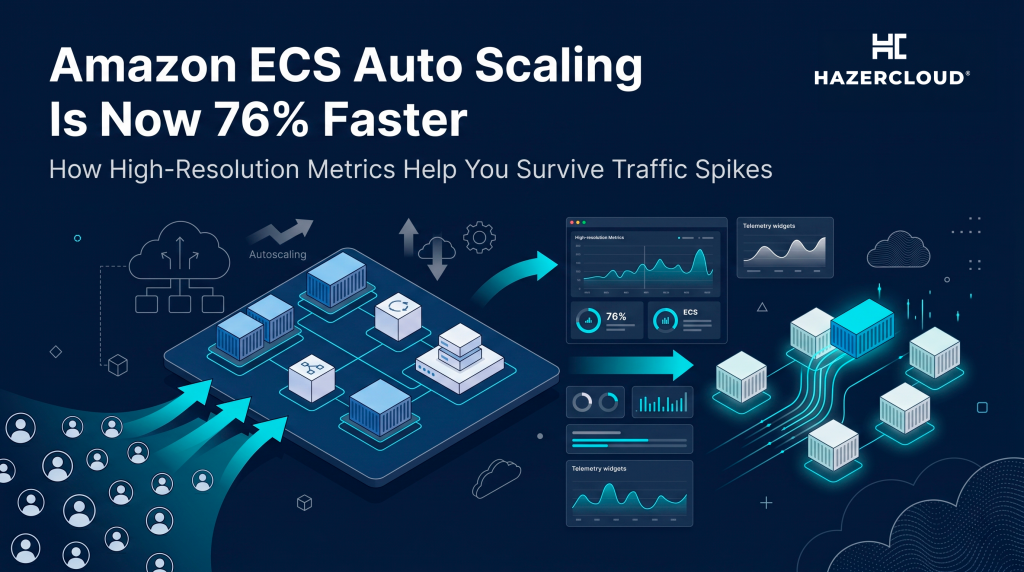
If your business runs containers on Amazon ECS, there is a quiet but important gap between the moment your traffic surges and the moment new tasks are actually serving requests. For years that gap was long enough to hurt, because ECS scaled on metrics published every sixty seconds and a minute is a very long time when a marketing email just landed in fifty thousand inboxes or a product went viral. AWS has now closed most of that gap with high-resolution metrics for ECS service auto scaling, and the numbers are big enough that any team running customer-facing workloads should pay attention. ECS Auto Scaling now supports high-resolution metrics that enable Amazon ECS services to react up to 76% faster to traffic spikes, helping businesses improve application performance while reducing the need for over-provisioning.
The short answer is this. ECS target tracking policies for CPU and memory now support twenty-second metric resolution alongside the old sixty-second default, and in AWS benchmarks that cut the time to trigger a scale-out from 363 seconds to 86 seconds, roughly 76 percent faster, while the total time to detect load and have new tasks running dropped from 386 seconds to 109 seconds. It works across Fargate, ECS Managed Instances and EC2, you opt in per service, and the only real cost is a small CloudWatch charge for the higher-resolution metrics. If you have ever watched a traffic spike outrun your scaling, this is the setting you have been waiting for.
Why a Minute of Lag Is a Business Problem
Auto scaling exists so you do not have to pay for peak capacity around the clock, but it only works if it reacts before your users feel pain. With sixty-second metrics, the scaler could not even see a CPU spike until up to a minute after it started, then it waited for the metric to breach the target, then it asked for new tasks, then those tasks had to be placed, started and pass health checks. Stack those delays together and you can be six minutes into a surge before fresh capacity is taking traffic. For a checkout flow, a signup page or an API your customers depend on, six minutes of saturated tasks means slow responses, timeouts and abandoned sessions, which is lost revenue rather than an abstract latency number.
The usual workaround was to over-provision, running far more tasks than you need most of the day just so you have headroom when the spike hits. That works, but you pay for it every hour of every day to cover a handful of busy minutes. Faster scaling changes the trade. When the scaler reacts in a minute and a half instead of six, you can run leaner baselines with confidence that the system will catch up quickly when demand arrives. That is a direct line from an engineering setting to your cloud bill and your customer experience at the same time.
What AWS Actually Changed
The mechanism is simple, which is part of why it is appealing. ECS now publishes two new predefined metrics, ECS Service Average CPU Utilization High Resolution and ECS Service Average Memory Utilization High Resolution, at twenty-second resolution rather than the standard sixty seconds. You attach a target tracking scaling policy to one of these high-resolution metrics, and the scaler now gets three readings a minute instead of one. More frequent, fresher data means it detects a breach far sooner and acts on it sooner, which is where the headline 4.2x improvement in time to trigger comes from.
Crucially this is not limited to one flavour of ECS. It works the same across AWS Fargate, the newer ECS Managed Instances and classic EC2 backed services, so you do not have to change your compute model to benefit. You also keep all the existing scaling tools alongside it. Target tracking on high-resolution metrics handles the sudden reactive spikes, while scheduled scaling still covers known events like a Monday morning rush and predictive scaling still smooths recurring daily patterns. The high-resolution option is an upgrade to the reactive layer, not a replacement for the whole strategy.
The Catch: Faster Scaling Is Not Free, and Tasks Still Take Time to Start
Two honest caveats keep this grounded. First, the high-resolution metrics carry an additional CloudWatch cost because you are publishing and storing data three times as often, whereas the standard sixty-second metrics are free. For most services the spend is small and easily justified by avoiding over-provisioning, but it is worth turning on deliberately for the services that face spiky, customer-facing load rather than blanket enabling it on every internal batch worker that does not care about a minute of lag.
Second, faster detection only fixes the part of the delay that ECS controls. The scaler can now ask for new tasks in well under two minutes, but those tasks still have to pull an image, start the container and pass health checks before they take traffic. If your container image is bloated or your application takes ninety seconds to warm up, that becomes the new bottleneck. The teams that get the most from this change pair it with slim images, fast health checks and sensible startup so that once ECS decides to scale, the capacity actually arrives quickly. Faster signalling and fast-starting tasks are two halves of the same win.
What to Do About It
Start by identifying the handful of services where a traffic spike actually hurts customers, the checkout, the login, the public API, the webhook receiver, rather than trying to change everything at once. For those services, configure twenty-second resolution for CPU or memory in the monitoring section when you create or update the service, then point a target tracking policy at the matching high-resolution metric. You can do this from the console, the CLI, CloudFormation or the SDKs, so it fits whatever infrastructure-as-code setup you already run. Then test it honestly by generating a realistic load spike against a staging service and watching how quickly new tasks come online, and while you are there, measure your container start time so you know whether image size or warm-up is now your limiting factor. Finally, once scaling is quicker and more reliable, revisit your baseline task counts and trim the over-provisioning you were carrying as insurance, because that is where this change pays for itself.
If you would rather not spend a sprint tuning auto scaling, load testing and container start times yourself, HAZERCLOUD can do it for you. We design and operate ECS and Fargate platforms for growing UK, US and European businesses, tuning scaling policies so they react in seconds, trimming wasted baseline capacity, and making sure your containers start fast enough to keep up. Book a free consultation and infrastructure assessment at https://hazercloud.com/contact/ and we will show you where your current scaling is leaving you exposed and what it is costing you.
