



GDPR-Compliant Cloud Hosting: What UK and EU Businesses Get Wrong on AWS
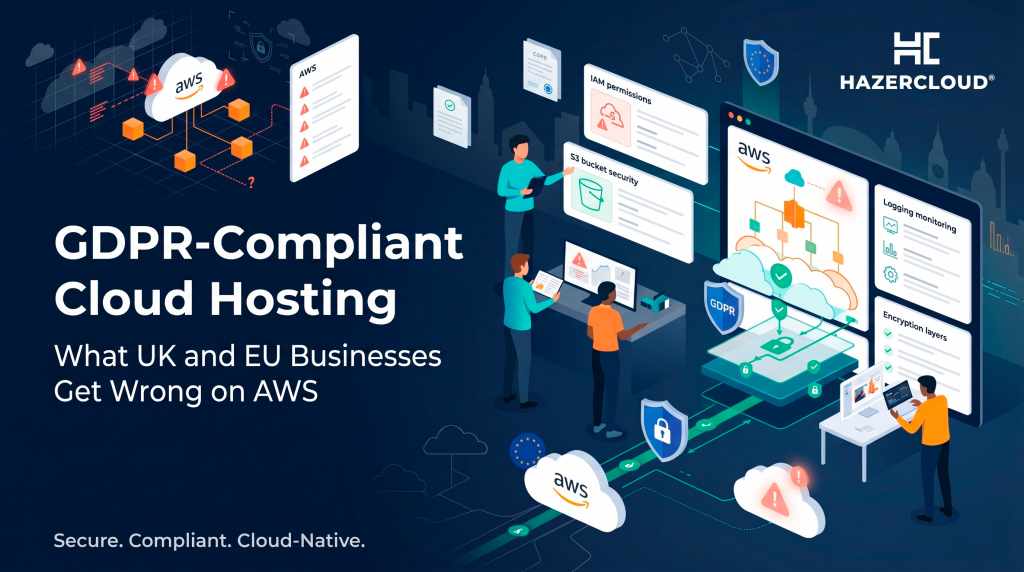
If your business serves customers in the UK or Europe, you already know that GDPR is not optional. What you might not know is how many companies running workloads on AWS are getting compliance wrong not because they ignored the rules, but because they assumed AWS was handling things that AWS explicitly says are your responsibility. With fines reaching up to €20 million or 4% of global annual turnover, whichever is higher, the cost of getting this wrong is not theoretical.
The short answer to whether AWS is GDPR-compliant is yes but only on their side of the fence. AWS holds certifications including ISO 27001, ISO 27017, ISO 27018, and SOC 2. They offer data processing agreements and region-specific infrastructure across Europe. But compliance is a shared responsibility, and the part that lands on your desk is where most businesses stumble.
The Shared Responsibility Blind Spot
AWS operates on a shared responsibility model, which means they secure the cloud infrastructure itself the physical data centres, the networking hardware, the hypervisors while you are responsible for everything you put in the cloud. That includes how you configure your services, who has access to your data, how you handle encryption, and whether your data processing practices actually comply with GDPR.
The problem is that many business owners hear “AWS is GDPR compliant” and treat it as a finished sentence. In practice, regulators in the UK and across the EU now expect organisations to take full ownership of their cloud compliance posture, not just point to their provider’s certifications. If a customer submits a data subject access request and your team cannot locate, export, or delete their personal data across your AWS environment within the required timeframe, that is your liability not Amazon’s.
Data Residency Is Not Just a Settings Toggle
One of the most common mistakes UK and EU businesses make is assuming that selecting an AWS region in Europe means their data stays there. While AWS does allow you to choose specific regions like London, Frankfurt, Paris, or Stockholm, data can still move across borders through replication settings, backup configurations, CDN caching, or third-party integrations that route traffic through US-based services.
Since the Schrems II ruling, transferring personal data outside the EU or UK requires additional safeguards such as Standard Contractual Clauses or binding corporate rules. If your application uses a US-based analytics tool, a SaaS email provider, or even a logging service that stores data in Virginia, you may be transferring data without realising it. Auditing your full data flow not just your primary database location is essential, and it is something most businesses have never done thoroughly.
Shadow IT and Unmanaged Services
Another overlooked risk is shadow IT within your AWS account. Development teams spin up new services, test environments, and storage buckets without always following the same compliance processes that were applied to production. Personal data can end up in S3 buckets without encryption, in CloudWatch logs without retention policies, or in development databases that nobody remembers to decommission.
GDPR requires you to know where personal data lives across your entire infrastructure, and AWS accounts have a tendency to sprawl. Without proper tagging, access controls, and regular audits, your compliance posture erodes quietly over time.
Why This Matters More in 2026
European data protection authorities have become noticeably more active in enforcement over the past year. The trend across the UK’s ICO, France’s CNIL, and Germany’s state-level authorities is toward larger fines and more scrutiny of cloud-hosted operations specifically. New frameworks like ISO 27017 for cloud security and CSA STAR are becoming baseline expectations rather than optional extras. If your business handles health data, financial records, or any special category data under GDPR, the bar is even higher.
At the same time, cloud adoption continues to accelerate across European businesses. More data is moving to AWS than ever before, which means more surface area for compliance gaps. The companies that treat GDPR compliance as a one-time checkbox exercise during migration are the ones most likely to face problems down the line.
What You Can Do About It
Start with a data flow audit. Map out exactly where personal data enters your AWS environment, where it is stored, where it moves, and who can access it. Pay particular attention to cross-border transfers, third-party integrations, and any services your team has provisioned outside of the standard deployment process.
Review your AWS configuration against GDPR requirements. That means checking encryption at rest and in transit, verifying that IAM policies follow least-privilege principles, ensuring S3 buckets are not publicly accessible, and confirming that your backup and logging retention policies align with your data retention commitments.
Put a process in place for handling data subject requests. You need to be able to locate, export, and delete an individual’s data across your entire AWS footprint within 30 days. If you cannot do that today, it is a gap worth closing before a request arrives.
Finally, consider whether your team has the cloud and compliance expertise to manage this on an ongoing basis, or whether working with a specialist makes more sense. GDPR compliance on AWS is not a one-off project it requires continuous monitoring, configuration management, and awareness of evolving regulations.
At HAZERCLOUD, we help UK, EU, and Middle East businesses build and maintain AWS environments that are secure, compliant, and cost-effective from day one. If you are unsure where your GDPR gaps are, we can help you find them before a regulator does. Get in touch
