


Kuwait’s CBK CORF Framework: What It Means for Banks Running on AWS
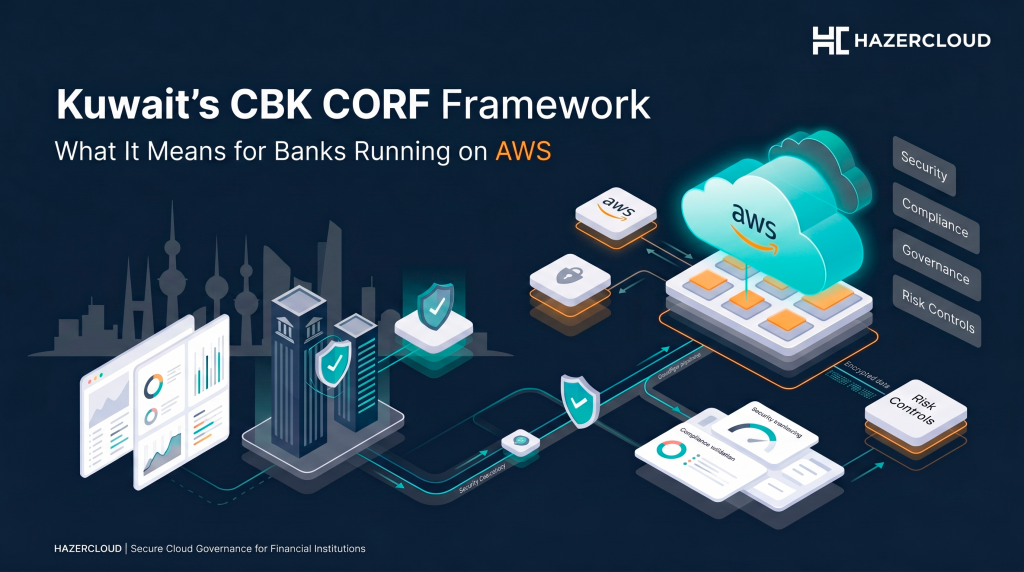
If your financial institution operates in Kuwait and you’re using or planning to use AWS, the Central Bank of Kuwait just raised the bar. In December 2025, the CBK replaced its 2020 Cybersecurity Framework (CSF) with the far more demanding Cyber and Operational Resilience Framework, known as CORF. It applies to every CBK-regulated entity in the country, from local and foreign banks to exchange companies, finance houses, e-payment providers, and open banking platforms.
The question most technology and compliance leads are now asking is straightforward: can we meet CORF requirements while running workloads on AWS? The short answer is yes, but it takes deliberate architecture, governance, and operational discipline. Simply hosting in the cloud and hoping for the best will not satisfy the CBK’s expectations under this new framework.
Why CORF Is a Big Deal
The previous CSF had 4 domains and 291 controls. CORF has 27 domains, 93 sub-domains, 200 control areas, and 876 individual controls. That is not a minor revision it is a wholesale expansion of what the CBK considers baseline security and resilience for the financial sector.
The framework is structured around six key areas: governance, risk and compliance, technology and operations, third-party risk management, emerging technologies, and payment security and operational resilience. It aligns with international standards including NIST, ISO 27001, and COBIT, which means institutions already mapped to those frameworks have a head start, but there are Kuwait-specific requirements layered on top that demand local attention.
Crucially, CORF moves beyond the idea of simply preventing attacks. The CBK now expects institutions to anticipate, withstand, adapt to, and recover from disruptive cyber and operational events. That lifecycle approach not just “keep the bad guys out” but “keep running even when something goes wrong” changes how you need to think about your AWS environment.
Where AWS Fits into the CORF Picture
AWS provides a strong foundation for meeting many CORF controls, particularly around infrastructure security, encryption, logging, and availability. The AWS Middle East (Bahrain) Region, which launched in 2019 with three Availability Zones, gives Kuwait-based institutions a nearby option for low-latency, regionally hosted workloads. AWS also offers Outposts for institutions that need to run certain services on-premises within Kuwait itself, which can help address data residency considerations.
On the compliance side, AWS supports 143 security certifications and standards globally, including ISO 27001, ISO 27017, ISO 27018, PCI DSS Level 1, and SOC 1, 2, and 3. These map directly to several CORF control areas around technology operations, data protection, and access management.
However and this is where many institutions underestimate the effort AWS operates on a shared responsibility model. AWS secures the infrastructure, but you are responsible for how you configure it, who has access, how data is classified and protected, and how your applications behave under stress. CORF places the accountability squarely on the regulated entity, not on the cloud provider.
The Third-Party Risk Challenge
One of CORF’s most significant expansions is around third-party risk management. When you run workloads on AWS, the CBK considers AWS a critical third-party provider. That means your institution needs documented due diligence on AWS as a vendor, ongoing monitoring of the relationship, clear contractual provisions around security and data handling, and a tested exit strategy in case you need to move off the platform.
This is not just a procurement exercise. CORF requires institutions to demonstrate that they understand the concentration risk of relying on a single cloud provider and have contingency plans in place. It also means understanding the sub-processor chain who AWS itself relies on and how data flows across borders. The US CLOUD Act, for instance, can create complications even when data is physically hosted in Bahrain, since AWS is a US-headquartered company. Institutions need to account for this in their data governance and risk assessments.
Building a CORF-Ready AWS Environment
Meeting CORF on AWS is not about checking boxes on a spreadsheet. It requires a coherent approach across architecture, operations, and governance. That starts with designing your AWS environment around resilience from day one multi-AZ deployments, automated failover, immutable infrastructure patterns, and well-tested disaster recovery runbooks that map to the CBK’s expectations for recovery time and recovery point objectives.
On the operational side, institutions need continuous monitoring and logging through services like AWS CloudTrail, Guard Duty, and Security Hub, configured to generate the audit evidence CORF demands. Identity and access management needs to follow least-privilege principles enforced through AWS IAM policies, with MFA mandated across the board something the April 2026 Cyber Essentials reset in Kuwait now requires explicitly for all cloud services.
The CBK also requires annual independent CORF audits by approved third-party firms, aligned with supervisory tiering and risk profiling. That means your AWS environment needs to be audit-ready at all times, with clear documentation, tagged resources, and traceable change management processes.
What This Means for Your Cloud Strategy
For banks and financial institutions in Kuwait, CORF is not optional and it is not something you can address retroactively. If you are already on AWS, now is the time to run a gap assessment against the 876 controls and identify where your current configuration falls short. If you are planning a migration to AWS, building CORF compliance into the architecture from the start is far less expensive and disruptive than retrofitting it later.
The institutions that treat CORF as a catalyst rather than a burden will come out ahead. A well-architected, resilient AWS environment does not just satisfy the regulator it genuinely protects the business, reduces downtime, and builds customer trust in a market where digital banking is accelerating fast.
HAZERCLOUD works with financial institutions across the Middle East to design and manage AWS environments that meet regulatory requirements like CORF from the ground up. If you need a gap assessment, architecture review, or hands-on help getting your AWS environment CORF-ready, get in touch.
