



Amazon S3 Just Killed the 30-Day Wait Before Infrequent Access: How Same-Day Lifecycle Transitions Cut Your Storage Bill
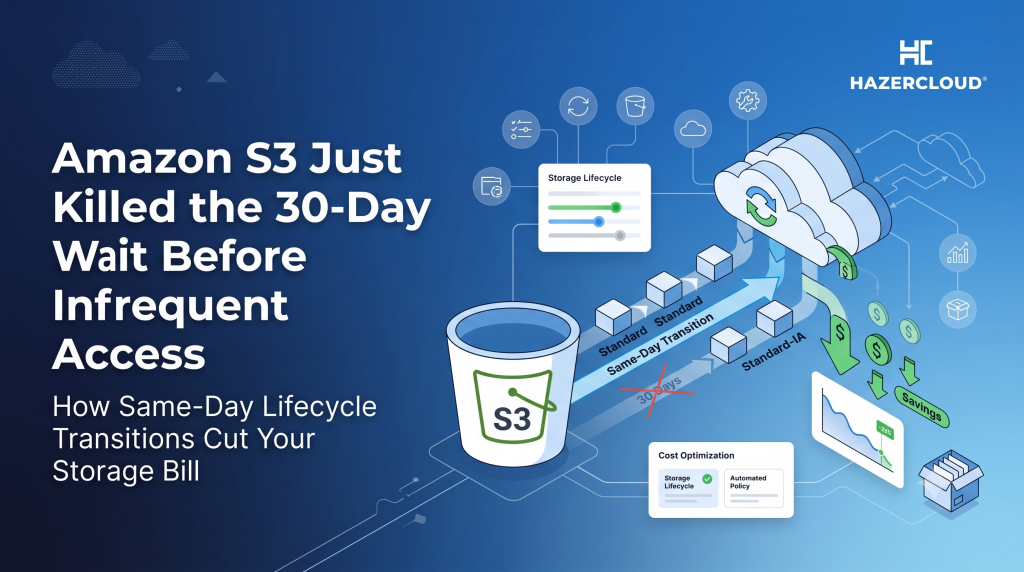
On 16 July 2026, AWS quietly removed one of the oldest constraints in Amazon S3. You can now transition objects into S3 Standard-Infrequent Access and S3 One Zone-Infrequent Access on the day they are created, rather than waiting out a 30-day minimum residency in S3 Standard first. If your business writes logs, backups, CI artefacts, database snapshots or compliance exports into S3, you have been paying the full S3 Standard rate on data that went cold within hours. That first month of storage was a tax you could not avoid. Now you can.
The short answer is this: create a new S3 Lifecycle rule with a transition at 0 days after creation, targeting S3 Standard-IA or S3 One Zone-IA, and you immediately stop paying $0.023 per GB per month for data nobody reads after the first afternoon. Standard-IA is $0.0125 per GB per month and One Zone-IA is $0.01 per GB per month, so the saving on that first 30-day window is roughly 46 to 57 percent on the storage line. The change works in every AWS Region where those two storage classes are available and it requires no application change, no data migration and no downtime. What it does not do is remove the 30-day minimum billing duration or the 128 KB minimum billable object size, and that distinction is where most teams will get this wrong.
The Data: What S3 Storage Classes Actually Cost in 2026
Storing 1 TB in S3 Standard costs roughly $23.55 per month in us-east-1 before request fees and data transfer, according to CloudZero’s 2026 S3 pricing analysis. That is the number most teams never revisit after their first week on AWS. Below is a comparison of the millisecond-access storage classes, retrieved from AWS pricing documentation and independent cost analyses on 21 July 2026.
| Storage class | Storage price (us-east-1, per GB per month) | Retrieval fee | Minimum billable object size | Minimum billing duration | Earliest lifecycle transition (as of 16 Jul 2026) |
|---|---|---|---|---|---|
| S3 Standard | $0.023 (first 50 TB) | None | None | None | n/a |
| S3 Standard-IA | $0.0125 | $0.01 per GB | 128 KB | 30 days | Day 0 (was day 30) |
| S3 One Zone-IA | $0.01 | $0.01 per GB | 128 KB | 30 days | Day 0 (was day 30) |
| S3 Glacier Instant Retrieval | $0.004 | $0.03 per GB | 128 KB | 90 days | Day 0 |
| S3 Glacier Deep Archive | $0.00099 | Per-GB retrieval applies | 40 KB | 180 days | Day 0 |
Three findings stand out. First, the spread between the cheapest and most expensive S3 class is roughly 23 times, from $0.023 per GB down to $0.00099 per GB, and Cloud Burn’s analysis notes that most finance teams do not know that gap exists. Second, One Zone-IA is 20 percent cheaper than Standard-IA because it holds data in a single Availability Zone, while still being designed for eleven nines of durability against disk, host and rack failure. Third, the wider picture is not flattering: Flexera’s 2025 State of the Cloud report put wasted cloud spend at 27 percent, unchanged since 2023, and at Gartner’s forecast of $675 billion in global cloud infrastructure spend for 2025 that is roughly $182 billion evaporating every year.
Why the 30-Day Rule Cost Real Money
Think about what actually lands in your buckets. Application logs shipped every five minutes. Nightly RDS snapshots exported to S3. Container image layers and build artefacts from every CI run. CloudTrail and VPC Flow Logs. Data exports that a compliance officer might read once, eighteen months from now, if there is an audit. In every one of those cases the access pattern collapses within hours. The object is written, maybe read once by a downstream job, and then sits there.
Under the old rule, that object still had to serve out 30 days in S3 Standard before a lifecycle rule could touch it. For a team writing 10 TB of new log data every month, that is 10,240 GB paying an extra $0.0105 per GB for a month, roughly $108 a month or $1,290 a year, on storage the business had already stopped reading. Scale that to 100 TB a month and it is about $1,075 a month, or nearly $13,000 a year, from a single line in a lifecycle policy. Those are not enormous numbers on their own, which is precisely why nobody fixed them. They were invisible, they were unavoidable, and they were spread across a dozen buckets owned by four different teams.
The other cost was architectural. Because the platform could not move data early, teams built workarounds. Some wrote objects directly to Standard-IA from the application using the storage class header, which meant the storage decision lived in application code and drifted the moment someone deployed a new service. Others ran custom Lambda functions that copied objects between classes, which is a copy operation, a new object, new PUT charges and a new object age clock. Others just gave up and left everything in Standard. Now the platform does it declaratively, which is where that logic belongs.
The Trap: Same-Day Transition Does Not Mean Same-Day Deletion
Here is the part that will bite teams who move fast. AWS removed the minimum time an object must spend in S3 Standard before transitioning. It did not remove the minimum billing duration inside the IA classes. Once an object lands in Standard-IA or One Zone-IA, you are committed to 30 days of billing for it. Delete it, overwrite it, or transition it onward to Glacier before day 30 and you pay a pro-rated charge covering the remainder of that 30-day window.
That changes the maths for short-lived data. If your build artefacts are expired after seven days, moving them to Standard-IA on day 0 does not save you money. You pay seven days of IA storage plus a pro-rated penalty for the missing 23 days, and you have gained nothing over leaving them in Standard, where there is no minimum duration at all. The rule of thumb is straightforward: same-day IA transitions pay off when the object is cold quickly but retained for at least 30 days. If retention is shorter than 30 days, leave it in Standard.
The second trap is object size. Standard-IA and One Zone-IA both bill a minimum of 128 KB per object. If your buckets are full of small JSON events or thumbnail images averaging 20 KB, you will be billed as though each one were 128 KB, and a class that looks 46 percent cheaper per GB can end up more expensive in practice. Scope your lifecycle rules with an object size filter so only objects above 128 KB are transitioned. That filter exists precisely for this reason and most teams never set it.
The third trap is retrieval. Standard-IA and One Zone-IA both charge $0.01 per GB retrieved. Data that turns out to be warmer than you assumed will quietly hand back the savings through retrieval fees. Before you write the rule, check S3 Storage Lens or S3 Storage Class Analysis for the actual access pattern of the prefix you are about to move.
Standard-IA or One Zone-IA
One Zone-IA is 20 percent cheaper because it stores data in a single Availability Zone rather than a minimum of three. AWS still designs it for 99.999999999 percent durability against independent disk, host and rack failures, but an Availability Zone loss means data loss. That makes it a reasonable home for anything you can regenerate or that already exists somewhere else: secondary copies of backups whose primary lives in another Region, CI artefacts you could rebuild from source, processed data derived from a raw dataset you still hold.
It is a poor home for your only copy of anything. If losing an AZ means losing the data and nobody can recreate it, pay the extra $0.0025 per GB per month for Standard-IA. The difference on 100 TB is about $256 a month, which is a small price for not having a very difficult conversation with your board.
What to Do About It
Start with visibility rather than policy. Turn on S3 Storage Lens across the organisation if it is not already on, and look at two things: total bytes by bucket, and the age distribution of objects. Then use S3 Storage Class Analysis on your three largest buckets to see when objects actually go cold. You are looking for prefixes where access drops off within days and retention runs to months or years. Log buckets, snapshot exports and compliance archives will usually show up first.
Then write the rules in the right order. For each qualifying prefix, add a lifecycle rule with a transition at 0 days to Standard-IA or One Zone-IA, apply an object size filter above 128 KB, and add a later transition to Glacier Instant Retrieval or Glacier Deep Archive at whatever point access effectively stops, remembering that Glacier classes carry their own 90 and 180 day minimums. Confirm the expiration rule sits beyond the 30-day IA minimum so you never pay an early-deletion penalty. Apply the change to one bucket, wait a full billing cycle, and check Cost Explorer with a storage class dimension before rolling it across the estate.
Finally, treat this as an infrastructure-as-code change, not a console click. Lifecycle rules written by hand in the console are the ones that get deleted by accident and never noticed. Put them in Terraform or CloudFormation alongside the bucket definition, review them like any other change, and revisit them each quarter as access patterns shift.
If your S3 bill has been growing quietly while nobody owned it, this is a good week to look. HAZERCLOUD helps founders and engineering leaders across the UK, Europe and the US run leaner, safer AWS estates, from storage lifecycle policy and FinOps reviews through to full platform builds and migrations. If you want a second pair of eyes on where your cloud spend is actually going, book a free consultation and migration assessment with HAZERCLOUD and we will walk your architecture with you.
