



Serverless vs Containers on AWS: A Plain-English Guide for Business Owners in 2026
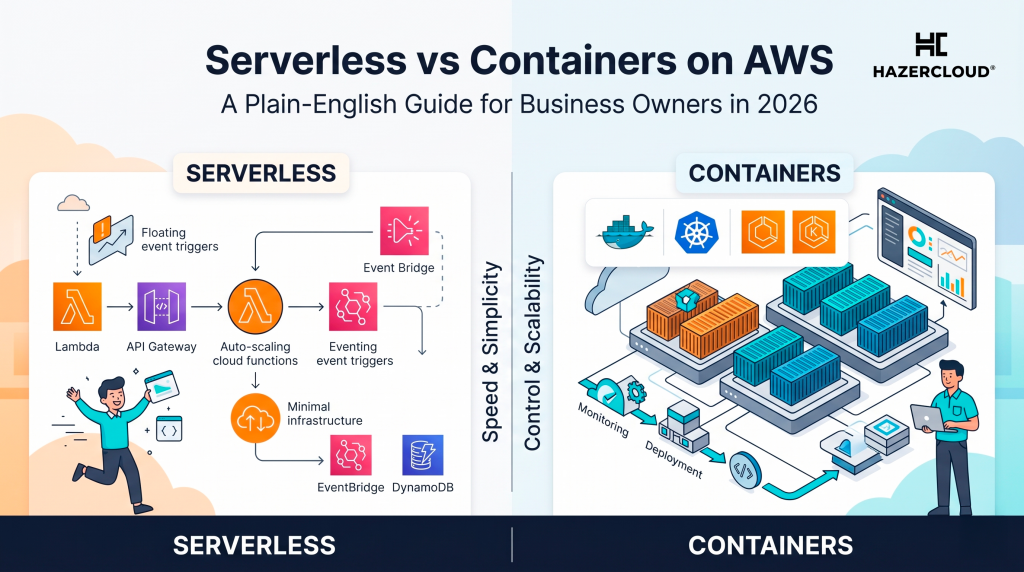
Every growing business that runs on AWS eventually has the same argument inside its engineering team. One side wants to build everything on AWS Lambda because it scales automatically and you only pay when code runs. The other side wants to put everything in containers on AWS Fargate or Amazon ECS because they are predictable, portable, and cheaper for steady workloads. Both sides are partly right, both sides are partly wrong, and as a business owner you are the one being asked to bless the decision. The good news is that the serverless vs containers AWS debate is a lot less religious than it used to be, and there is now a clear framework for picking the right tool for the right job.
The short answer for most growing businesses on AWS in 2026 is this. Use serverless for unpredictable, event-driven, or bursty workloads where you do not want to pay for idle capacity. Use containers for steady, always-on workloads or anything with specific runtime, dependency, or performance needs. And expect to use both, because around 78 per cent of engineering teams now run hybrid architectures that combine the two. The real question is not which one is better, it is which one fits each piece of your business.
When Serverless Wins
AWS Lambda, and the broader serverless family that includes services like AWS Step Functions and Amazon EventBridge, is at its best when traffic is unpredictable or low duty cycle. Think of an order confirmation that fires when a customer checks out, an image-resize job triggered when someone uploads a photo, a nightly report that runs once a day, or an API that gets a thousand requests in the morning and ten in the afternoon. In those scenarios serverless is genuinely cheaper, because you pay per invocation and per millisecond of compute, with nothing running in between. For workloads under roughly fifty thousand invocations a day, Lambda usually wins on cost by a wide margin.
The other big win is speed to market. A small team can ship a working serverless service in days rather than weeks, because you are not provisioning servers, configuring load balancers, or building deployment pipelines from scratch. For startups, internal tools, prototypes, and anything that needs to validate fast, serverless removes a lot of unglamorous work. UK and European businesses with small engineering teams often find serverless lets them punch above their weight.
When Containers Win
Containers on AWS Fargate, Amazon ECS, or Amazon EKS make more sense the moment your workload starts looking like a real, always-on application. If you are running a customer-facing service that handles steady traffic above roughly fifty per cent duty cycle, containers are typically fifty to eighty per cent cheaper than Lambda for the same work. Containers also win when you have specific runtime requirements that Lambda cannot satisfy, when you need long-running processes, when your application has substantial dependencies, or when your team already has Docker and Kubernetes skills that would be wasted by going fully serverless.
Containers are also a better fit when portability matters. If you might one day want to run the same workload in another region for data residency reasons, on a private cloud for a regulated customer, or even on Amazon EKS Anywhere on-premises for an EU client with strict data sovereignty requirements, a containerised application moves with you. A Lambda function does not.
The Hidden Costs Nobody Tells You About
The serverless vs containers AWS conversation usually focuses on per-invocation versus per-hour pricing, but in real bills the surprises come from somewhere else. One recent case study found that Lambda compute was only twenty-two per cent of the total bill, and the other seventy-eight per cent came from data transfer, CloudWatch logs, NAT Gateway fees, and provisioned concurrency. Containers have their own hidden bills, including idle capacity on overprovisioned clusters, where more than eighty per cent of container spend is often wasted on idle resources. The honest answer is that both options can quietly cost much more than the headline price suggests, and the difference comes down to how carefully someone has designed and reviewed the architecture.
The Bigger Picture
The boundary between serverless and containers is also disappearing. AWS Fargate now offers per-second billing. AWS Lambda now supports container image packaging up to ten gigabytes. The compute decision is becoming less about which technology you pick and more about which usage pattern fits your workload. For business owners this is good news, because it means you do not have to make a permanent strategic bet. You can mix and match, and you can change your mind as your traffic patterns evolve.
What to Do About It
Start by mapping your workloads against two simple questions. Is the traffic steady or bursty? And do you need specific runtime control? Steady and predictable points to containers. Bursty and event-driven points to serverless. Specific runtime needs point to containers. Speed-to-market for a new service usually points to serverless. Once you have that map, get a second opinion before your team commits, because the cost difference between a well-designed and a badly-designed setup on either side is often three to five times the bill.
This is exactly the kind of architecture review HAZERCLOUD runs for growing businesses across the UK, US, and Europe looking at your workloads, your traffic patterns, your team’s skills, and your growth plan, and recommending the right mix of serverless and containers for each part of your business. If you want a clear answer rather than another internal debate, Get in touch and we will help you make the call.
AWS #Serverless #Containers #CloudComputing #CloudArchitecture #AWSLambda
