



Cloud Compliance in 2026: What UK and European Business Owners Actually Need to Know
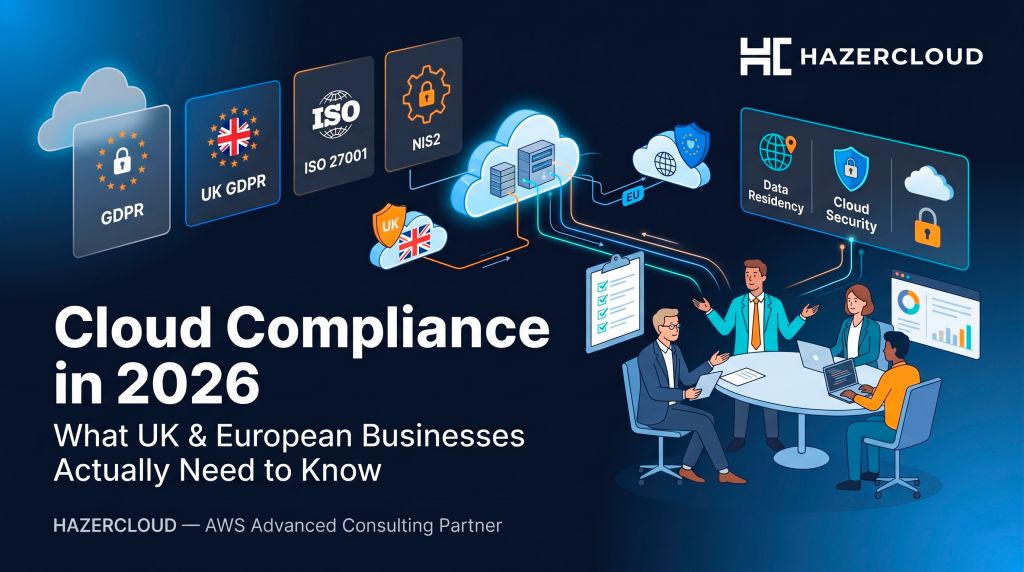
If you run a business that stores customer data in the cloud and in 2026, that’s most businesses the regulatory ground has shifted underneath you. Not dramatically, not in a way that made headlines on the BBC, but enough that what was compliant eighteen months ago might not be compliant today.
Between the UK’s Data (Use and Access) Act taking effect in February, a new Cyber Security and Resilience Bill moving through Parliament, and the EU renewing its data adequacy arrangement with the UK until 2031, there’s a lot to untangle. The good news is that none of this requires you to rip up your cloud setup and start over. The less good news is that ignoring it could now cost you up to 17.5 million pounds.
The Fines Just Got Serious
The change that matters most right now is one that flew under the radar for many business owners. When the Data (Use and Access) Act commenced on 5 February 2026, it quietly aligned fines under the Privacy and Electronic Communications Regulations (PECR) with UK GDPR levels. That means breaches related to cookies, marketing emails, and electronic tracking things that used to carry a maximum fine of 500,000 pounds can now result in penalties of 17.5 million pounds or 4% of global annual turnover, whichever is higher.
If your business runs any kind of digital marketing, uses tracking cookies, or sends email campaigns, this isn’t abstract regulatory news. It’s a direct change to your financial exposure. The ICO hasn’t suddenly become aggressive overnight, but the toolkit it has at its disposal is now significantly sharper, and enforcement expectations around transparency and consent have risen in step.
Data Can Still Flow Between the UK and EU – For Now
One piece of genuinely good news: in December 2025, the European Commission renewed the EU-UK adequacy decision for another six years, through to December 2031. Personal data can continue to move freely between the European Economic Area and the UK without additional safeguards like Standard Contractual Clauses.
That said, the renewal came with conditions. The European Data Protection Board flagged several areas it wants the Commission to monitor closely, including how the UK reshapes the Information Commissioner’s Office and how national security exemptions to data protection law evolve. There’s a formal review baked in after four years, with the power to suspend or revoke adequacy if the UK diverges too far from EU standards.
For business owners, this means you don’t need to panic about cross-border data transfers today. But if you operate across both markets, building your cloud architecture with data residency flexibility in mind is a smart long-term move. AWS now offers regions across Ireland, Frankfurt, London, Paris, Stockholm, Milan, and Spain and in January 2026, it launched the European Sovereign Cloud in Brandenburg, Germany, a physically and logically separate infrastructure designed specifically for organisations with strict EU data sovereignty requirements.
A New Cybersecurity Law Is Coming for Cloud Providers
The UK’s Cyber Security and Resilience Bill, currently in its Committee stage in Parliament, is the country’s answer to the EU’s NIS2 Directive. While it’s not expected to fully come into force until 2027 or 2028, the direction of travel is clear: managed service providers and cloud computing services are being brought firmly into the regulatory scope.
The Bill introduces a new category called “Relevant Managed Service Providers” essentially, any organisation providing ongoing management of IT systems for customers in the UK. If you use a managed cloud provider, or if you are one, this will matter. The Bill also expands incident-reporting obligations and increases enforcement powers.
For business owners who rely on third-party cloud or IT providers, the practical takeaway is this: you’ll increasingly be expected to demonstrate that your supply chain meets defined cybersecurity standards. Choosing a cloud partner who already operates to these standards and who can document it will become a competitive advantage, not just a compliance checkbox.
What This Means Across the UK, EU, and Beyond
Whether you’re based in London, Berlin, Dublin, or New York serving European customers, the trajectory is consistent: regulators expect you to know where your data lives, who can access it, and what happens when something goes wrong. The EU’s NIS2 Directive is already in force and covers a broader range of sectors than the UK’s Bill. Businesses operating across both jurisdictions need to track both frameworks and build their compliance posture to meet the stricter of the two.
The practical challenge for most mid-sized businesses isn’t understanding the regulations in theory it’s translating them into decisions about cloud architecture, vendor contracts, and internal processes. Which AWS region should you deploy in? Do you need a Data Processing Agreement with every SaaS tool you use? What does your incident response plan look like if there’s a breach?
What You Should Do About It Right Now
Start with an audit of where your data actually sits. Many businesses migrated to the cloud over the past few years without much thought about region selection or data residency and now is a good time to map that out. Check that your AWS (or other cloud) workloads are deployed in regions that align with your compliance obligations for UK businesses handling UK customer data, the London region is the obvious choice, but EU customers may require an EU-based region.
Next, review your cookie and marketing consent mechanisms. With PECR fines now at GDPR levels, your cookie banner and email opt-in processes are no longer a “nice to have” compliance gesture. Make sure they’re defensible.
Finally, talk to your cloud provider or managed services partner about their readiness for the Cyber Security and Resilience Bill. If they can’t explain their incident response process, their data residency controls, or their security certifications in plain English, that’s a red flag worth taking seriously.
Cloud compliance in 2026 isn’t about fear it’s about building the kind of infrastructure and processes that protect your customers and your business at the same time. If you want help assessing where you stand and what needs to change, get in touch HAZERCLOUD works with UK and European businesses to build compliant, resilient cloud environments on AWS.
